
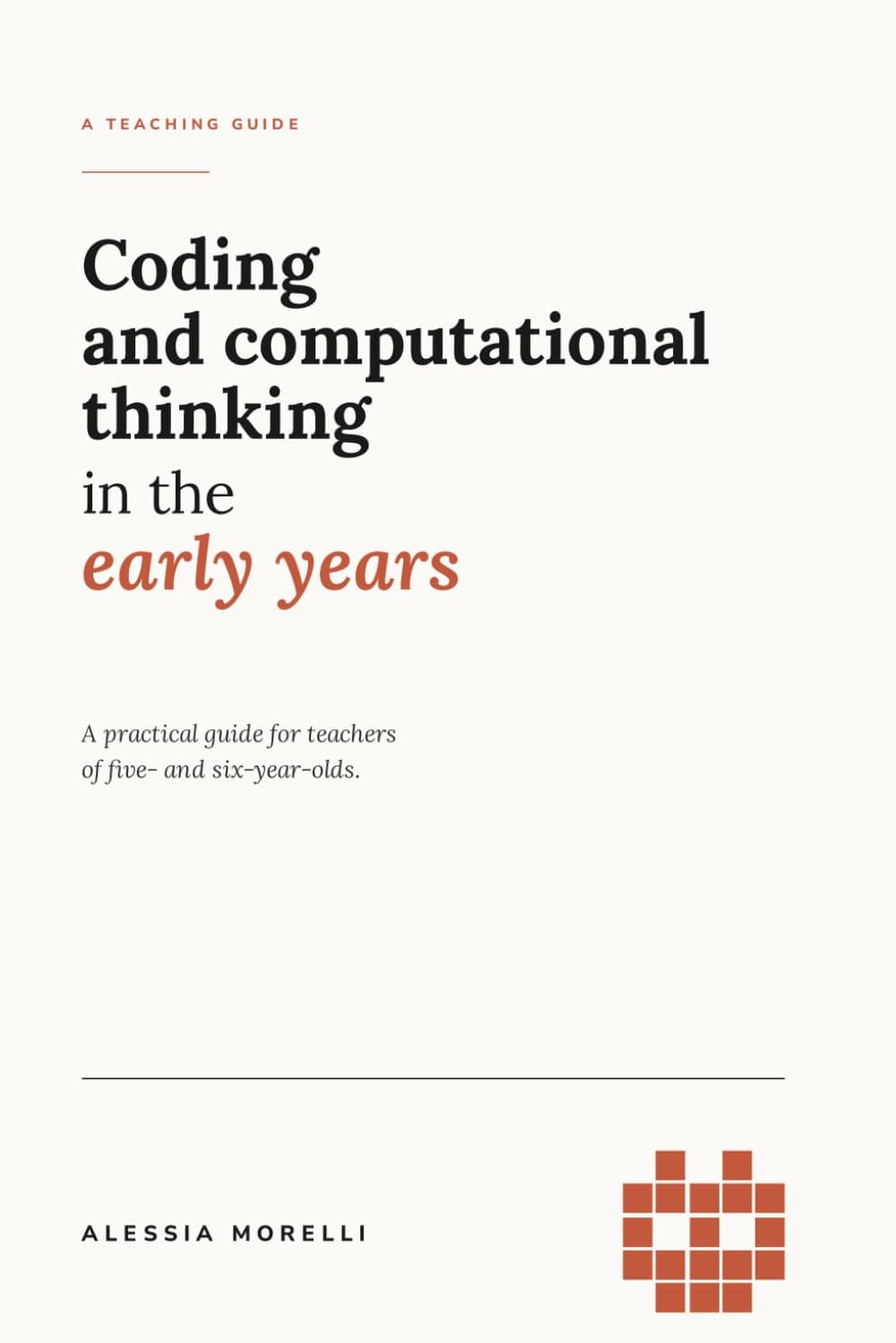
New book · English edition
Coding and Computational Thinking in the Early Years
By Alessia Morelli - a practical guide for teachers of five- and six-year-olds to introduce coding and computational thinking without screens and without needing to be "good with technology". Paperback, 158 pages.
Buy on Amazon UKAlso on Amazon.com · Amazon.it
Italian edition: Coding e pensiero computazionale nella scuola dell'infanzia
About the book
Coding and Computational Thinking in the Early Years starts from a simple idea: young children already think computationally. They sort, sequence, spot patterns and solve problems every day. The teacher's job is to make these skills visible and give them the right contexts, language and materials, with intention, confidence and joy. The book treats mistakes as the main doorway to learning, for children and teachers alike, and keeps screens to a minimum: short, guided sessions only when they add something.
Almost everything is unplugged, built with card, masking tape and felt-tip pens. No robot required. It is the English edition of my Italian guide for the scuola dell'infanzia, adapted for teachers working with five- and six-year-olds, and grounded in years of classroom experience. See also the glossary of educational coding on this site.
Paperback, 158 pages, published 24 September 2026. ISBN 979-8176729726.
What's inside
The foundations
What computational thinking is, its four pillars, and why it matters so much in the early years.
Explaining the computer
Hardware and software, binary numbers, pixels, codes and the internet, through games and simple metaphors.
Dozens of unplugged activities
Child robots on floor grids, pixel art, stories in sequence, patterns, loops and conditions, with low-cost materials.
Tangible robots
Bee-Bot and Cubetto, themed mats and how to make your own.
A cautious approach to screens
Short, guided sessions with ScratchJr and Code.org.
Planning and ready-to-use tools
Units of work, year-long projects, observation and documentation, families, transition to primary school. Ten complete activities plus twenty in brief, observation grids, checklists, template letters, an illustrated story, glossaries and a printable manifesto.
Who it's for
- Teachers of five- and six-year-olds in early years settings and reception classes
- Teachers new to coding who are not "good with technology" and want a clear starting point
- Early years leads and coordinators planning a year-long approach to computational thinking
- Settings on a tight budget: almost everything works with card, tape and pens
Frequently asked questions
Is this a translation of the Italian book?
Do I need to know how to code?
Do I need robots or tablets?
How does it differ from Little Coders?
Where can I buy it?
Want a training session or workshop for your setting?
I run teacher training and workshops on coding and computational thinking, in person in north-east Italy and online internationally, including Erasmus+ and eTwinning projects.